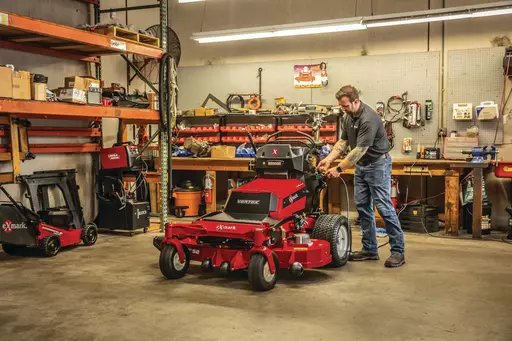
How to Integrate Electric Mowers into Your Fleet
by Exmark Manufacturing
Discover how Exmark’s line of electric mowers can grow your lawn care fleet into a cost-effective, fully charged productivity machine.
Key Takeaways
Electric mowers are a strategic upgrade that complement gas units while helping landscape contractors meet growing noise, emissions, and sustainability expectations.
Assess before you invest by mapping property types, routes, run times, and storage to choose the right mix of electric walk-behind, stand-on, and ride-on mowers.
Set crews up for success with clear communication, operator training, and updated SOPs for charging, inspections, and daily use.
Build smart, scalable charging based on daily energy needs, shop layout, electrical capacity, and mobile charging requirements.
Track performance and grow in phases by monitoring runtime, costs, and operator feedback, then expand your electric fleet where it delivers the strongest ROI.
The Case for Electric Mowers
For years, gas-powered mowers have been the backbone of commercial lawn care fleets. Alongside each of their strengths, however, come a few realities: fuel price swings, regular engine maintenance, and long shifts where crews deal with higher noise and vibration levels. Today, commercial electric mowers provide lawn care businesses with quiet, low-maintenance performance that can help reduce operating costs over time, ease crew fatigue, and support compliance with noise and emissions guidelines.
At a high level, Exmark electric mowers are battery-powered, professional-grade machines designed to deliver the same cut quality, durability, and productivity you expect from their gas-powered counterparts, all with a few added benefits:
Quieter Operation: Electric mowers are much quieter than gas-fueled models due in large part to the virtually silent operation of their electric motors, swapping combustion engines and exhaust noise for lithium-ion batteries and belt-free motors.
Zero Engine Emissions: Battery-powered mowers don’t produce any engine-related emissions, reducing the need for respirators and bolstering adherence to zero engine emission mandates.
Reduced Maintenance: Thanks to durable brushless motor technology that drives blades or wheels directly, without belts, electric mowers typically require much less maintenance than their gas-powered counterparts.
Long-Lasting Batteries: Exmark’s commercial electric stand-on and zero-turn riding mowers are powered by the state-of-the-art HyperCell system, delivering up to seven hours of runtime on a single charge. Paired with easy-to-swap batteries, your fleet can stay energized and ready to handle jobs of virtually any size or duration.
Flexible Charging Capabilities: Any household 120v socket will work to charge any Exmark electric mower. That said, the HyperCell-powered Vertex V-Series stand-on and Lazer Z V-series zero-turn models will charge considerably faster using a 220v outlet.
As you consider how electric mowers fit into your business, it’s important to understand that the opportunity goes well beyond simply swapping fuel for batteries. This guide will walk through how to successfully onboard new electric mowers with crews, design practical charging infrastructure around your routes and facilities, monitor operational performance to validate your investment, and put the right safety and security practices in place.
Electric mowers offer the opportunity to position your business as a forward-looking leader focused on delivering the highest service quality while minimizing environmental impact.
Assessing Readiness and Planning Electric Fleet Integration
Before adding the first electric mower to your fleet, it’s worth stepping back to understand how your business operates today. A bit of upfront analysis helps to avoid surprises and maximize the return on investment in battery-powered mowers.
Start by mapping the work crews actually do. List the types of properties you service (small, high-density sites vs. large campuses or municipal spaces) and note terrain challenges such as slopes, rough ground, or tight obstacles.
Look at daily run times and route lengths: how many hours is each mower cutting each day, and how far do crews travel between stops? Use this in conjunction with our mower productivity charts to estimate how much battery capacity you’ll need, how many batteries each crew should carry, and where those batteries will be stored safely on your trucks, and in your shop or garage.
Armed with this information, start matching specific electric mower models to those jobs. Compact walk-behind and stand-on units may be ideal for tighter urban residential accounts, while commercial electric zero-turn riders are better suited to larger properties.
Model
Deck Width
Best Suited for...
Key Features
42" Deck
Primarily residential properties, and homeowners who want an electric mower to maintain 1–2 acre lots.
Flex-Force powered residential zero-turn with 42" Electric Series 2 deck.
Electric drivetrain with instant torque and no belt-related maintenance.
Runs up to ~60 minutes on four 10-Amp Flex-Force batteries, with capacity to add two additional batteries for extended runtime (ideal for light-duty or homeowner-focused routes).60” Deck
Large commercial properties, campuses, sports fields, municipal open spaces, and high-acreage routes where productivity per hour matters most.
HyperCell powered commercial zero-turn rider with up to 7+ hours of runtime per charge.
Adapt-equipped 60" Electric Series 4 cutting deck; Horizon360 Connect remote software for app-based access to settings, location, and usage.
Ideal primary unit for all-day commercial routes.
52” Deck
Dense commercial sites, campuses with obstacles, medians, gated communities, and mixed-terrain properties where agility and sightlines matter.
HyperCell powered stand-on platform with up to 7 hours of runtime.
52" Electric Series 4 deck; dual-action controls and wideset 20" drive tires for maneuverability over varied terrain.
Horizon360 Connect remote software for tracking and diagnostics, great for crews that need to hop on/off frequently.
30” Deck
Small to mid-size turf areas, gated properties, narrow access points, townhomes, HOAs, and trim work where a 21" is smaller than ideal but a rider is too large.
Flex-Force powered commercial walk-behind with fabricated, welded 30" steel deck.
Built on the same deck, wheels, and height-of-cut system as the gas-powered Commercial 30.
Includes three 60V, 10 Ah batteries plus rapid charger.
21” Deck
Tight spaces, detail work around landscaping, boulevards, park strips, and small residential or HOA properties with strict noise rules.
Flex-Force powered 21" walk-behind using the same die-cast aluminum deck, wheels, and transmission as gas-powered Commercial 21 models.
Two 60V, 7.5 Ah batteries plus high-speed charger included.
Excellent for finishing work, gated areas, and early-morning or noise-sensitive sites.
Perform a basic assessment of your available electrical capacity and identify early constraints like panel limits or parking layouts that affect charger placement. Decide which gas units to replace first; typically high-use machines, units dedicated to noise-sensitive sites, or equipment nearing the end of its life.
As you map that transition, consider total cost of ownership and long-term ROI: fuel and maintenance savings, potential incentives, improved operator comfort, and the ability to win or retain accounts that prioritize low-noise, low-emission service.
Building Smart Charging Infrastructure and Protecting Your Investment
Building and maintaining the right charging infrastructure is what transforms electric mowers into a reliable, productive part of your fleet. Even the best equipment will underperform if chargers are hard to access, electrical panels are overloaded, or batteries aren’t where crews need them. When thoughtfully planned out, teams should be able to plug in, power up, and be ready for the next day without extra headaches or downtime.
Begin by getting a handle on your daily energy needs, then design a setup that fits your shop. A simple framework for owners and managers could look like this:
Estimate daily demand: Multiply the number of electric mowers in use by their average hours of operation and battery capacity to get a rough idea of how much energy you’ll need to replace each night.
Lay out your charging zone: Decide where trucks, trailers, and mowers will park and how operators will move through the space at the end of the day. Plan charger placement and cable routing to keep walkways clear and minimize trip hazards.
Check your electrical panel: Work with a licensed electrician to confirm panel capacity, add dedicated circuits where needed, and plan for future expansion as additional electric units are introduced to the fleet.
Consider mobile charging options: For satellite yards or routes that stay in the field all day, explore trailer-mounted or vehicle-based charging solutions that enable batteries to be charged away from the shop.
Finally, protect your investment with basic safety and security practices tailored to electric mowers. Train crews on proper battery handling, including not using damaged connectors, and always following manufacturer guidelines. Store batteries in clean, dry, well-ventilated areas away from extreme heat, and keep chargers and cords off the floor when possible to reduce wear and tear.
Integrating Electric Mowers into Daily Operations
Bringing electric mowers into daily operations starts with getting your crews onboarded. Before you ever hand over a new machine, explain why the business is investing in battery-powered mowers: more comfortable workdays, quieter jobs on noise-sensitive sites, a stronger position with high-value clients, and long-term cost control that helps keep the company healthy. Use this time to address common misconceptions and reinforce that these are professional-grade tools designed to work alongside, not replace, familiar gas units.
From there, focus on practical training to protect operational performance from day one. Treat onboarding new electric mowers just like you would a new truck or major piece of equipment:
Walk through starting and stopping procedures, including any safety interlocks or indicators unique to each model.
Train operators on reading state-of-charge and planning their work so they’re never surprised by a low battery.
Reinforce blade care and deck cleanliness, since sharp blades and clean decks are critical to cut quality and maximizing runtime.
Show crews how to inspect cables, connectors, and batteries, and how to report issues before they become downtime.
Document these points in your SOPs and assign roles so it’s clear who handles charging, who performs daily checks, and who tracks performance feedback from the field.
Finally, integrate electric equipment into your scheduling and routing in a way that plays to its strengths. Align early deployments with routes that match expected run times and easy access to charging, such as properties closer to the shop or accounts where quieter battery-powered mowers are a clear advantage. Adjust start times or job order if needed so electric units tackle the most demanding mowing while batteries are at their highest charge. Over time, use real-world data from your crews to refine routes, decide where additional batteries or chargers are needed, and determine which future accounts are ideal candidates for electric service.
Measuring Operational Performance and Scaling Your Electric Fleet
Once electric mowers have been integrated into your fleet, start treating their data as a management tool. Start by monitoring operational performance at the route and unit level: run time per charge, acres mowed per shift, and any patterns in downtime or derating. Compare how different crews and property types can impact results.
Over a few weeks, you’ll begin to see which routes are the best fit for electric mowers, where additional batteries might be needed, and whether certain operating habits (like dull blades or aggressive transport speeds) are cutting into productivity. From there:
Layer on a simple KPI framework to validate your investment and keep profitability front and center.
Track fuel savings versus the gas units you’ve replaced, changes in service and maintenance costs, and any differences in uptime or repair frequency.
Don’t overlook operator feedback; the decreased noise, lower vibration, and reduced end-of-day fatigue all contribute to employee satisfaction and retention, which have real costs.
Together, these metrics give you a clear picture of ROI over time and provide the confidence to make informed decisions about where to deploy more electric equipment, where gas still makes sense, and how to balance the mix across your fleet.
Use what you’ve learned to plan the cost-effective growth of your electric fleet in phases, targeting routes and accounts where electric delivers the most value. Along the way, partnering with your local Exmark dealer for product selection, ongoing fleet integration support, charging expansion, and service can help ensure each new electric mower is put to work where it makes the biggest impact on your bottom line.
Conclusion
By taking a structured approach to electric mower integration—assessing your current routes and properties, onboarding crews with clear training and updated SOPs, building smart charging infrastructure, monitoring operational performance, and then scaling in phases—you can capture the real advantages of battery power without disrupting your day-to-day work.
Exmark’s V-Series electric lineup, including HyperCell-powered commercial zero-turn riders and stand-ons and Flex-Force walk-behinds, is designed specifically to support that journey, delivering the cut quality, durability, and runtimes commercial crews depend on. To take the next step, contact your local Exmark dealer to review your current fleet, identify the best electric models for your routes, and map out a customized electric fleet integration plan.